Ecommerce Management vs Ecommerce Marketing: What's the Difference
Most store owners find out the hard way: your ads are converting fine, but orders still ship late, stock still runs out, and returns still pile up in an inbox nobody checks. That’s the moment people usually realize they’ve been thinking about “growing an ecommerce store” as one job when it’s actually two very different ones — ecommerce management and ecommerce marketing.
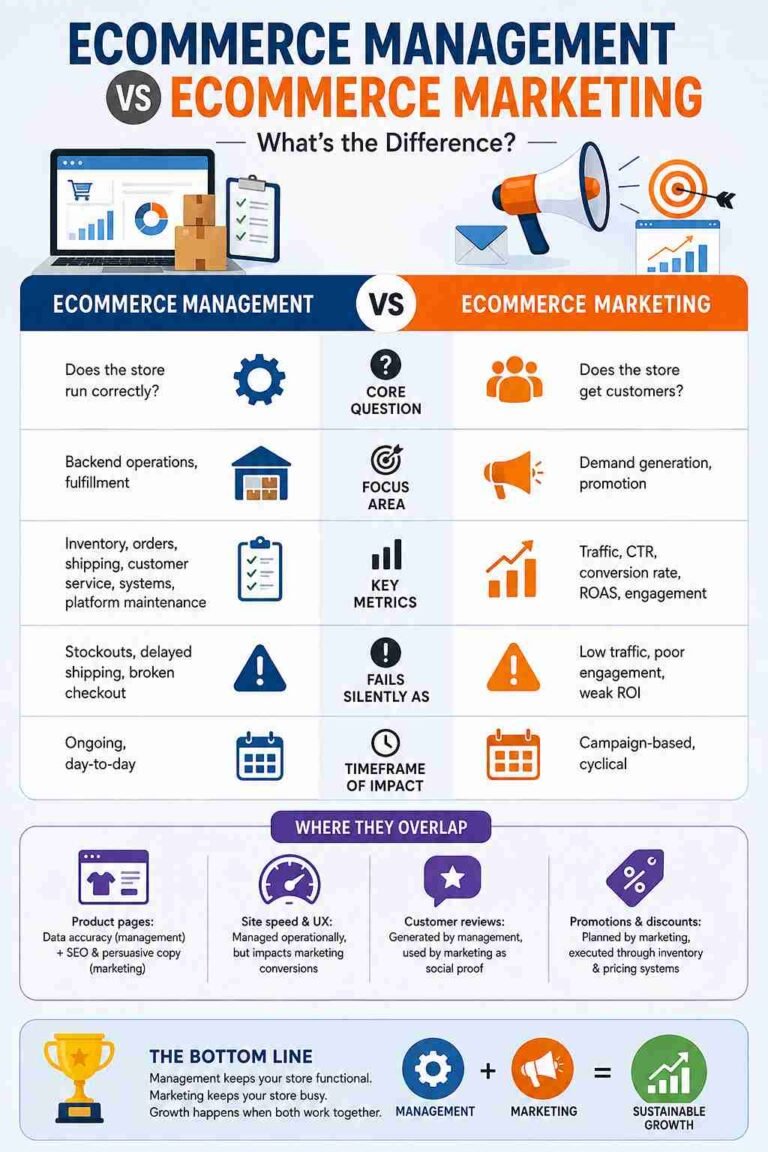
Ecommerce management is the backend operations side — inventory, order fulfillment, catalog upkeep, payment and shipping systems, customer service, and the platform itself running smoothly. Ecommerce marketing is demand generation — getting people to your store in the first place through ads, SEO, email, and content, then convincing them to buy. One keeps the store functional. The other keeps it busy. You need both, but they solve different problems, and confusing them is why a lot of “marketing isn’t working” complaints are actually operations problems in disguise.
What Ecommerce Management Actually Covers
Ecommerce management is everything that happens after someone lands on your site and everything that has to be true before they ever get there. It’s the operational backbone:
- Inventory and catalog management — stock levels, product listings, variants, pricing accuracy across channels
- Order fulfillment — processing, packing, shipping, tracking updates, delivery timelines
- Platform maintenance — uptime, page speed, checkout functionality, payment gateway reliability
- Customer service operations — returns, refunds, order queries, complaint resolution
- Systems and integrations — connecting your store to ERP, accounting, shipping partners, and marketplaces so data flows without manual re-entry
None of this is glamorous, and none of it shows up in a campaign report. But if fulfillment is slow, stock data is wrong, or checkout breaks on mobile, no amount of traffic fixes that — it just means more people see the problem.
What Ecommerce Marketing Actually Covers
Marketing is the demand side — the reason a stranger becomes a visitor, and a visitor becomes a customer:
- Paid acquisition — Google Ads, Meta Ads, marketplace ad placements
- SEO and content — product page optimization, blog content, category page structure
- Email and retention marketing — abandoned cart flows, post-purchase sequences, loyalty campaigns
- Conversion rate optimization — pricing display, product photography, offers, landing page structure
- Brand and positioning — how the store is perceived against competitors
Marketing’s job is measured in traffic, click-through rate, and conversion rate. It answers “did enough people come, and did enough of them buy” — not “did the order actually reach them on time.”
Where the Two Actually Overlap
They’re not fully separate, which is exactly why people mix them up. A few places they collide:
- Product page content sits in both camps — accurate stock/spec data is a management concern, while persuasive copy and SEO is a marketing concern.
- Site speed and checkout UX are managed operationally but directly affect marketing’s conversion numbers — a slow site quietly kills ad ROI.
- Customer reviews get generated through management (post-delivery follow-up, service quality) but get used by marketing (social proof on landing pages).
- Promotions and discount campaigns are planned by marketing but executed through inventory and pricing systems that management controls.
This is usually where things break down for smaller teams — marketing runs a big sale, and operations wasn’t staffed or stocked for the resulting order volume.
A Quick Comparison
Ecommerce Management | Ecommerce Marketing | |
Core question | Does the store run correctly? | Does the store get customers? |
Focus area | Backend operations, fulfillment | Demand generation, promotion |
Key metrics | Order accuracy, fulfillment time, uptime | Traffic, CTR, conversion rate, ROAS |
Fails silently as | Stockouts, delayed shipping, broken checkout | Low traffic, poor engagement, weak ROI |
Timeframe of impact | Ongoing, day-to-day | Campaign-based, cyclical |
Why This Confusion Costs Stores Money
The pattern shows up constantly: a store spends heavily on ads, gets a spike in traffic, and then loses a chunk of that spend to backend issues — out-of-stock products still showing as available, delayed dispatch triggering refund requests, or a checkout page that times out under load. The marketing did its job. The management side wasn’t ready to catch what marketing sent it.
The reverse also happens. Operations run tight — fast shipping, clean inventory, responsive support — but the store gets almost no traffic because nobody’s actively doing SEO, running ads, or building an email list. Great operations with no demand generation is just a well-run store nobody visits.
Growth needs both functions working in sync, not one propping up for the other’s gaps.
Signs You're Missing One Side
Management gaps show up as: frequent stockouts on popular items, shipping delays becoming routine, a support inbox that never empties out, and product data that doesn’t match what’s actually in stock.
Marketing gaps show up as: traffic that’s flat or declining month over month, high bounce rates on product pages, an email list that’s never emailed, and sales that only happen during discount periods.
If both lists sound familiar, that’s usually a sign the store has been run reactively — fixing whichever fire is loudest that week — rather than with dedicated attention to each function.
1. Can one person handle both ecommerce management and marketing for a small store?
Early on, yes — many single-owner stores run both functions themselves. The strain usually shows up once order volume grows past what one person can track manually, which is when it makes sense to bring in dedicated support for at least one side.
2. Which one should a new store prioritize first?
Operations need to be functional before marketing spend makes sense — there’s little point driving traffic to a store that can’t fulfill orders reliably. Once fulfillment and catalog accuracy are stable, marketing becomes worth investing in seriously.
3. Does ecommerce management include the website itself?
Yes — platform uptime, checkout functionality, and technical performance fall under management, since they’re operational requirements rather than promotional activity.
4. Is SEO part of management or marketing?
Technical SEO (site speed, structured data, crawlability) overlaps with management since it touches platform health. Content SEO (keyword targeting, blog content, on-page copy) sits under marketing.
5. How do I know if a drop in sales is a marketing problem or a management problem?
]Check traffic and conversion rate first. If traffic is steady but sales dropped, look at operations — stock availability, checkout errors, shipping delays. If traffic itself has fallen, that’s a marketing-side issue.
6. Do marketplaces like Amazon or Flipkart need separate management from a store's own website?
Yes, largely. Each marketplace has its own inventory sync, fulfillment rules, and listing requirements, so management effort typically has to be duplicated per channel even if marketing messaging stays consistent.
7. What's the biggest mistake stores make by treating these as one job?
Running a big marketing push without checking whether operations can handle the resulting order volume — leading to stockouts, delayed shipping, and refund requests that undo the marketing gains.
8. Does customer service belong to management or marketing?
Day-to-day order and returns support is a management function. But how that service experience gets talked about — reviews, testimonials, word of mouth — feeds back into marketing.
9. Can outsourcing management free up more budget for marketing?
Often, yes — outsourcing repetitive operational tasks (order processing, catalog updates, basic support) can reduce the internal time spent on backend work, leaving more attention and budget for growth activities.
10. Should management and marketing use the same tools or dashboards?
Ideally they’re connected — inventory and order data feeding into marketing decisions (like pausing ads on low-stock items) prevents the exact overlap problems described above.