Custom Website Development vs Website Builders: What's Better for Your Business
If you’re stuck choosing between a drag-and-drop builder and custom website development, the honest answer is: it depends on how big you plan to grow. A builder gets you online fast and cheap. Custom development gets you a site built around your business instead of the other way around. Here’s how to tell which one actually fits.
The Real Difference Between the Two
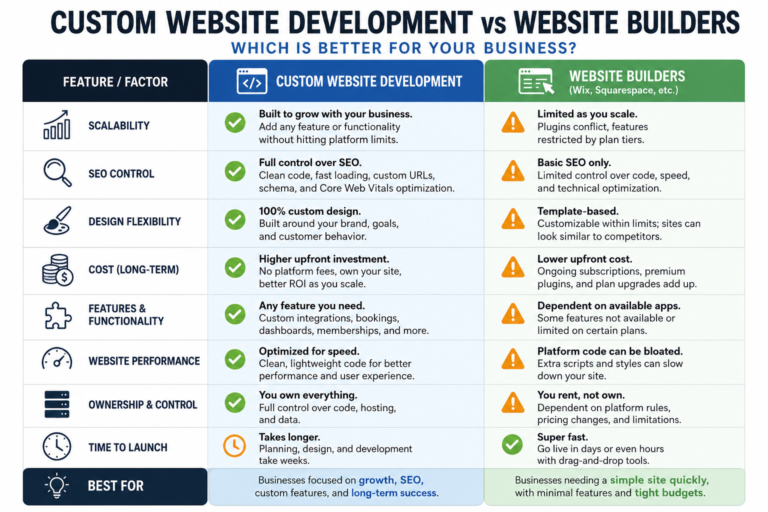
Website builders like Wix and Squarespace give you pre-made templates and a visual editor. You drag sections around, swap colors, plug in text, and you’re live in a weekend. Custom website development means a developer builds your site’s structure, features, and design from the ground up, matched to what your business actually needs — not what fits inside a template’s limits.
Neither is “wrong.” A local bakery announcing hours and a menu doesn’t need custom code. A growing service business trying to rank on Google, integrate booking systems, and scale traffic without breaking usually does.
Scalability: Where Builders Start Showing Cracks
Builders are fine at small scale and painful past it. Add a booking system, a membership area, a multi-language setup, or a product catalog with a few thousand SKUs, and you’ll hit walls — plugin conflicts, page speed drops, or features that simply don’t exist on your plan tier.
Custom-built sites don’t have that ceiling. Since the codebase is yours, adding a new feature is a development task, not a hunt for a compatible app. Businesses that expect to add functionality over the next two or three years save themselves a rebuild by starting custom.
SEO Control: The Part Most People Underestimate
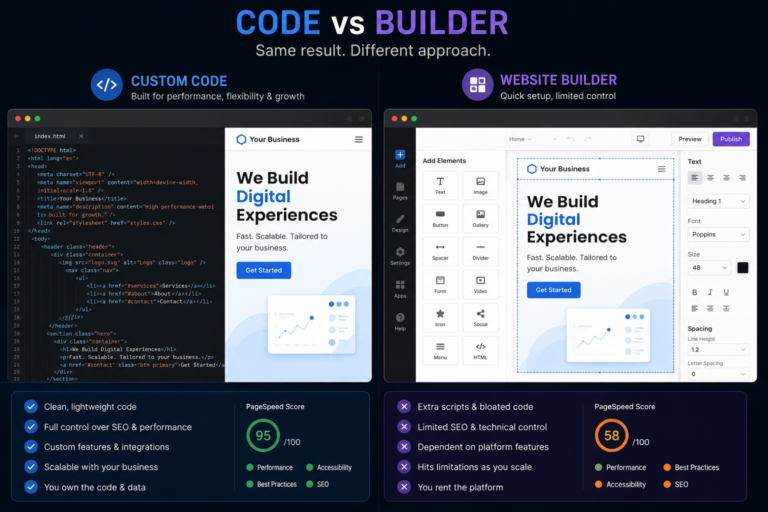
This is where the gap matters most. Builders handle basic SEO — title tags, meta descriptions, alt text — but they control the underlying code, and that code isn’t always built for speed or crawlability. You can’t touch server response times, can’t fully control URL structures on some plans, and you’re often stuck with bloated CSS/JS the platform ships by default, which drags down Core Web Vitals.
Custom development gives you the code itself. That means clean URL structures, fast load times, schema markup exactly where you need it, and no unnecessary scripts weighing the page down. If organic search is meant to bring you customers — not just visitors — this control isn’t optional, it’s the whole game.
Design Flexibility: Templates vs. Built-for-You
A builder template can be customized, but only within the boundaries the platform set. Two businesses on the same template often end up with sites that feel interchangeable, because the underlying layout logic is identical. Custom development starts with a blank canvas — the layout, interactions, and user flow are designed around how your specific customers actually behave, not around what a generic template assumed they would.
This matters more for businesses where the website is the sales pitch — agencies, consultancies, premium service providers — where a templated look can quietly undercut credibility before a visitor even reads a word.
Long-Term Cost: The Number That Changes Over Time
Builders win upfront. A monthly plan is far cheaper than hiring a developer, and there’s no arguing that. But costs shift as you scale — premium plugins, storage upgrades, and traffic-based plan jumps add up, and you’re still renting infrastructure you don’t own.
Custom development costs more initially, but you own the outcome. There’s no forced migration when a platform changes its pricing model, no feature ceiling that pushes you into a “we’ll rebuild it properly later” conversation. For a business planning to grow past year one, the true long-term cost often ends up lower with custom, not higher.
So Which One Should You Pick?
- Choose a builder if you need a simple, informational site live quickly, budget is tight, and you don’t expect major functionality changes soon.
- Choose custom development if SEO-driven growth matters, you’ll need custom features (bookings, dashboards, integrations), or your site needs to look distinctly different from every competitor using the same template library.
If you’re weighing this decision for a business that’s actively trying to grow, it’s worth looking at the full picture of what custom development covers — from planning to launch — on our Website Development Services page.
Is custom website development worth it for a small business?
It depends on the growth plan, not the current size. A small business planning to scale traffic, add features, or compete on SEO benefits from custom development early — retrofitting a builder site later usually costs more than starting custom
Can I switch from a website builder to custom development later?
Yes, but expect a near-total rebuild. Builder platforms lock your content and design into their own system, so migrating means recreating the site rather than transferring it.
Do website builders hurt SEO rankings?
Not automatically, but they cap how far you can optimize. Basic on-page SEO works fine; deeper technical SEO — site speed, custom schema, clean code — is limited by what the platform allows.
How much does custom website development typically cost compared to a builder?
Builders run on monthly subscriptions, often low upfront cost. Custom development is a larger one-time investment reflecting the design and development work, but there’s no ongoing platform rental or feature-tier lock-in.
Is Wix or Squarespace good enough for a service-based business?
For a very simple brochure site with no booking, integration, or catalog needs, yes. Once the business relies on the site to generate leads through search or handle transactions, the platform’s limits start showing up fast.
Does custom development mean starting completely from scratch every time?
Not always — some custom builds use frameworks or CMS platforms as a foundation, then customize the code around them. “Custom” refers to the freedom to build exactly what’s needed, not necessarily writing every line from zero.
How long does custom website development take compared to a builder?
A builder site can go live in days. Custom development takes longer — typically weeks — because it involves planning, design, and development work suited to the specific business rather than filling in a template.
Can a custom website still be easy to update after launch?
Yes, if it’s built on a proper CMS backend. The difference from a builder isn’t ease of editing content — it’s the flexibility of what can be built and how well it performs technically.
Will a custom website automatically rank higher on Google than a builder site?
No single build type guarantees rankings — content and strategy still matter most. What custom development changes is the ceiling: it removes technical limitations that can hold back an otherwise well-optimized site.
What's the biggest mistake businesses make when choosing between the two?
Picking based on today’s budget alone, without considering where the business will be in two years. That’s usually what forces an expensive rebuild sooner than expected.
Not sure which path fits your business?
Call 9718604362 for a quick, no-pressure conversation about what your site actually needs — or check out the full range of services on the Website Development Services page.