How to Choose the Right Website Development Company in Delhi
Choosing a website development company in Delhi comes down to four things: a portfolio that actually matches your industry, a hiring checklist you run before signing anything, clarity on the tech stack they’ll build with, and a project timeline they’re willing to commit to on paper. Skip any one of these and you’re gambling with your launch date, your budget, or both.
Delhi has no shortage of agencies and freelance developers promising “world-class websites” for prices that don’t add up. The problem isn’t finding someone who can build a website — almost anyone with basic coding knowledge can put pages online. The problem is finding a website developer in Delhi who understands your business goals, builds something that still works two years from now, and doesn’t disappear after the invoice is paid.
Start With a Real Hiring Checklist, Not a Gut Feeling
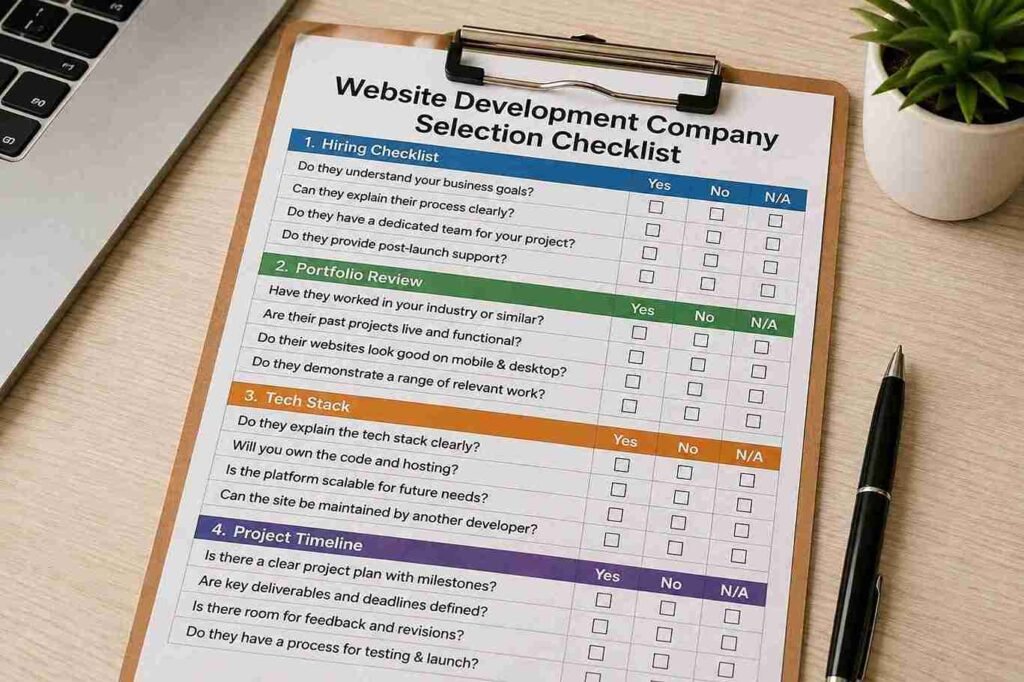
Most businesses hire based on a nice-looking sample site or a low quote. Neither tells you how the actual project will go. Before you talk pricing, run through this:
- Do they ask about your business before pitching a solution? A developer who jumps straight to “we’ll build you a 5-page site for ₹X” without asking what the site needs to do for you is guessing, not consulting.
- Can they explain their process in plain language? If every answer sounds like a sales script, that’s a red flag for how support requests will go later.
- Who actually writes the code? Some Delhi agencies quote a project and then outsource it to a third party you never meet. Ask directly.
- What happens after launch? Bug fixes, content updates, security patches — get this in writing before you start, not after something breaks.
None of this takes more than one honest conversation. If a company avoids straight answers on any of these, that tells you something too.
Portfolio Review: Look Past the Homepage
Anyone can show you five polished homepage screenshots. A proper portfolio review goes deeper:
- Open 2–3 of their past projects on your own phone and laptop, not just the screenshots they send you. Check load speed and how the layout holds up on a slow connection.
- Look for work in your own industry or something close to it — a website developer who’s built for e-commerce brands understands checkout flow and inventory logic differently than one who’s only built brochure sites for clinics or consultants.
- Ask what part of a specific project was actually theirs. Agencies sometimes showcase client sites where they only handled a small piece of the work.
- Check whether the sites are still live and still getting updated. A portfolio full of abandoned projects says something about long-term client relationships.
Tech Stack: Ask Before You Sign, Not After You're Stuck
This is where a lot of custom website development projects in Delhi quietly go wrong. The tech stack decides how expensive future changes will be, how fast your site loads, and whether you’re locked into one developer forever.
A few questions worth asking directly:
- Is this a custom-coded build, or built on a platform like WordPress, Shopify, or a website builder? Neither is automatically wrong — it depends on what you need — but you should know which one you’re getting and why.
- Who owns the code and hosting access once the project ends? Get this in writing. Some developers keep admin access as leverage for future work.
- Can another developer take over this codebase later if you ever switch teams? If the answer is vague, that’s usually because the code isn’t documented cleanly.
- Does the stack support what you’ll actually need in a year — more products, a booking system, multiple languages — or will it need a rebuild the moment you scale?
You don’t need to understand every technical term. You do need a developer willing to explain the choice in terms you understand, without brushing off the question.
Project Timeline: Get Milestones, Not Just a Deadline
“We’ll deliver in 4 weeks” is not a timeline — it’s a guess dressed up as a promise. A real project timeline breaks the work into stages with checkpoints you can actually see:
- Wireframes or design mockups delivered and approved
- Development milestone (homepage and core pages functional)
- Content integration and internal testing
- Client review round and revisions
- Final testing across devices and browsers
- Launch and post-launch check
If a company can’t break the timeline down this way, they likely haven’t planned the project — they’ve just estimated it. Delays are normal in web projects; what matters is whether you’ll actually know when something has slipped, instead of finding out three weeks past the original deadline.
Putting It Together
None of these four checks — hiring checklist, portfolio review, tech stack, project timeline — take unusual effort. They just require asking direct questions before money changes hands, not after. A website development company in Delhi that answers all four clearly, in writing, is worth far more than one that only impresses you with a slick pitch deck.
If you want to see how this actually plays out on a real project — from first conversation to launch — our website development services page walks through the process we follow with clients, including how timelines and tech stack decisions get made upfront.
Frequently Asked Questions
How much does custom website development cost in Delhi?
It depends heavily on scope — a brochure site and a custom platform with logins, payments, or bookings are entirely different projects. Get a scope-based quote rather than a flat number quoted before your requirements are even discussed.
Should I hire a Delhi-based developer or work remotely?
Being local helps if you want in-person meetings or same-city support, but it’s not a dealbreaker. What matters more is responsiveness and whether the process above (checklist, portfolio, stack, timeline) holds up, regardless of city.
How long does a typical business website take to build?
A straightforward business website usually takes 3–6 weeks once content and design are finalized. Anything faster for a genuinely custom site is worth questioning.
What's the biggest mistake businesses make when hiring a website developer in Delhi?
Choosing purely on price without checking who owns the code and hosting afterward. It’s the most common reason businesses feel “stuck” with a developer later.
Do I need a custom-built website, or is a platform like WordPress enough?
If your needs are mostly content and a contact form, a well-built platform site is often faster and cheaper to maintain. Custom development makes sense when you need specific logic — bookings, dashboards, integrations — that off-the-shelf platforms can’t handle cleanly. A good developer will tell you which one you actually need instead of pushing whichever they prefer building.
What should be included in a website development contract or proposal?
At minimum: scope of pages/features, tech stack being used, who owns the code and hosting after payment, number of revision rounds included, a milestone-based timeline, and what happens post-launch (support window, cost of future changes). If a proposal skips most of these, ask for them before signing.
Will I be able to update the website myself after it's built?
Ask this upfront, not after launch. Some builds hand you a proper CMS with editable pages; others quietly keep you dependent on the developer for every small text change. Confirm what you’ll be able to edit on your own and what will always need a developer.
How do I know if a developer's portfolio work is genuinely theirs?
Ask specifically what they built on a shown project — design, front-end, back-end, or all three — since agencies sometimes showcase client sites they only partly worked on. A developer who answers this precisely, rather than vaguely claiming full credit, is usually being straight with you.
What's a reasonable number of revision rounds to expect?
Most well-scoped projects include 2–3 rounds of revisions within the agreed design and development phases. Unlimited revisions sound generous but usually signal a vague scope, which tends to stretch the timeline indefinitely.
Is the cheapest quote ever the right choice?
Rarely, unless the scope is genuinely minimal. A quote well below others in the same city for the same requirements usually means shortcuts somewhere — outdated tech stack, no post-launch support, or code that’s hard to hand off later. Compare what’s included, not just the number.