Website Development Guide for Startups in Delhi NCR
If you’re a founder in Delhi NCR staring at three different agency quotes ranging from ₹15,000 to ₹5 lakh for what sounds like the “same website,” you’re not alone — and the confusion is usually a sign nobody’s explained what you’re actually paying for. Web development for startups Delhi NCR isn’t one product. It’s a set of decisions — MVP scope, budget allocation, tech choices, timeline — that either save you six months of rework later or cost you a relaunch you didn’t budget for.
This guide walks through those decisions in the order a founder actually needs to make them.
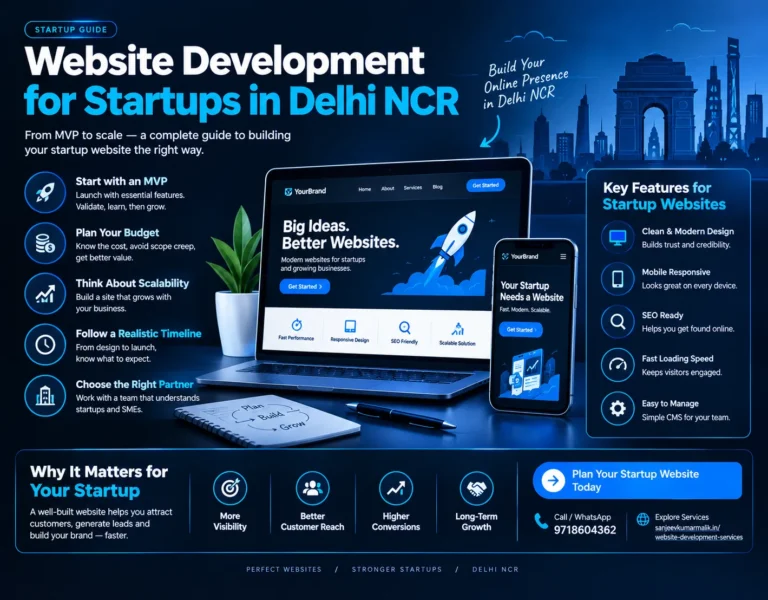
Start With an MVP Website, Not a "Complete" One
Most first-time founders try to launch with every feature they can imagine — blog, live chat, multi-language support, a booking system, a members’ area — before they’ve validated that anyone wants the core offer. That’s backwards.
An MVP website for a startup should answer three questions in under ten seconds: what do you do, who is it for, and what should I do next. Everything else — testimonials, detailed case studies, advanced filters, a resource library — can wait until you have real user behavior telling you what’s actually needed.
For an SME website development project, “minimum viable” doesn’t mean cheap or unfinished. It means scoped tightly around the one or two actions that actually move your business forward — a demo booking, a waitlist signup, a product inquiry — with everything built around getting that action right.
Budget Planning That Doesn't Blow Up Mid-Project
Delhi NCR startup budgets for a professional website typically fall into three tiers:
- Lean MVP (roughly ₹25,000–₹60,000): A focused 5–7 page site on a proven CMS, custom design within a flexible framework, core SEO setup, and one round of revisions. Right for pre-seed founders validating an idea.
- Growth-stage build (roughly ₹60,000–₹1.5 lakh): Custom UI/UX, more complex functionality (booking, payment integration, CRM connection), stronger on-page SEO structure, and performance optimization built in from day one.
- Scaling platform (₹1.5 lakh+): Fully custom development, headless architecture, integrations across multiple internal tools, and infrastructure planned for traffic spikes rather than steady-state load.
The mistake that actually breaks budgets isn’t picking the wrong tier — it’s scope creep after development starts. Lock your feature list before a single line of code gets written, and treat anything added mid-build as a separate, priced-out phase. Agencies that quote a flat fee with “unlimited revisions” baked in are usually padding the number to absorb exactly this risk; a clearer, milestone-based quote protects both sides better.
Scalability: Build for the Traffic You'll Have in 18 Months, Not Today
A startup website that works fine at 200 visitors a month can fall over at 5,000 if it was never built to scale. Three things determine whether your site scales without a rebuild:
Hosting architecture. Shared hosting is fine for validation-stage traffic. Once you’re running paid campaigns or expect a launch spike, you need hosting (or a CDN layer) that can absorb sudden load without your site timing out during the exact moment you’re getting the most attention.
Codebase choice. A site built on rigid page-builder plugins tends to slow down and get harder to extend as you add features. A cleaner separation between design and functionality — whether that’s a well-structured CMS setup or a custom framework — makes it far easier to add a new page, integration, or feature six months from now without touching the whole site.
Database and content structure. If your product catalog, blog, or user data isn’t structured with growth in mind from the start, “just add more content” eventually means “rebuild the data model.” This is the single most common reason SME websites need a costly overhaul 12–18 months after launch.
A Realistic Launch Timeline
Founders often get quoted “2 weeks” and then wait 8. Here’s what a launch timeline actually looks like when the scope is honest upfront:
- Discovery & scoping (3–5 days): Locking the MVP feature list, target pages, and content requirements.
- Design (1–2 weeks): Wireframes first, then visual design — this is where most founders should expect to give detailed feedback, not just approve.
- Development (2–4 weeks): Depends heavily on custom functionality. A lean brochure-style site moves faster than one with bookings, payments, or a custom dashboard.
- Testing & QA (3–5 days): Cross-device, cross-browser checks, load testing if you’re expecting launch traffic.
- Launch & handover (2–3 days): DNS, hosting setup, analytics tracking, and a walkthrough so you’re not locked out of your own site.
A realistic lean MVP timeline is 4–6 weeks end to end. Anything under two weeks for a genuinely custom build is either a template with your logo swapped in, or a timeline that’s going to slip.
FAQs
1. How much does website development cost for a startup in Delhi NCR?
A lean MVP site typically runs ₹25,000–₹60,000, while a growth-stage build with custom functionality can go up to ₹1.5 lakh or more, depending on features, design complexity, and integrations needed.
2. What's the difference between an MVP website and a full website?
An MVP website is scoped around one or two core actions (like lead capture or bookings) to validate your offer quickly. A full website adds depth — resource sections, advanced filtering, detailed case studies — once you know what your users actually respond to.
3. Should a startup use WordPress or a custom-built website?
It depends on your growth plans. WordPress (or another CMS) is faster and cheaper to launch and suits most early-stage sites. A custom build makes more sense once you need specific functionality a CMS can’t easily support, or you’re planning for heavy scale.
4. How long does it take to build a startup website in India?
A lean MVP typically takes 4–6 weeks from discovery to launch. Sites with custom features like payments, bookings, or dashboards usually take longer, closer to 6–10 weeks.
5. What features does a startup website actually need at launch?
At minimum: a clear homepage that states what you do, a way to contact or convert (form, booking, or inquiry), basic SEO setup, and mobile responsiveness. Everything beyond that should be added based on real user feedback, not assumptions.
6. How do I avoid scope creep blowing up my website budget?
Lock your feature list before development starts and treat any additions after that as a separate, priced phase. Vague quotes with “unlimited revisions” often hide the cost of scope creep rather than preventing it.
7. Does my startup website need to be built to scale immediately?
Not on day one, but the underlying architecture (hosting, codebase, data structure) should be chosen with 12–18 months of growth in mind, so you’re not forced into a full rebuild the moment traffic picks up.
8. What's a realistic budget split between design and development?
For most SME projects, design (including UX planning) takes roughly 30–40% of the budget, with development taking the remainder — though this shifts if you need heavy custom functionality like integrations or dashboards.
9. Can I launch a startup website without a large marketing budget?
Yes. A well-structured MVP site with solid on-page SEO can generate organic visibility even before you spend on paid campaigns — the key is getting the core structure and content right from the start.
10. What should I look for when hiring a website developer for my startup?
Look for someone who asks about your business goals before jumping to design, gives a milestone-based quote instead of a vague flat fee, and can explain their tech choices in plain terms rather than just naming tools.
Building an MVP right the first time saves you the cost of rebuilding it later. If you’re planning a startup or SME website and want the scope, budget, and timeline mapped out for your specific business, reach out to Sanjeev Kumar Malik — call or WhatsApp 9718604362, or check the full range of services at sanjeevkumarmalik.in/website-development-services.