Dark Mode Website Design: Is It Actually Worth Building for Your Audience?
Dark Mode Website Design: Is It Actually Worth Building for Your Audience? Dark mode is worth building when your visitors...
Read More → You’ve bid on the right keywords, written a sharp ad, and set a budget you’re comfortable with. Then the click lands on a page that doesn’t match what the ad promised — and half your traffic bounces before it even scrolls. That gap between the ad and the page is where most Google Ads budgets quietly leak away.
A landing page for Google Ads isn’t a scaled-down version of your homepage. It’s a single-purpose page built to do one thing: convert the exact visitor who clicked that exact ad. Get the message match, load speed, and CTA right, and your cost-per-click starts working a lot harder for you.
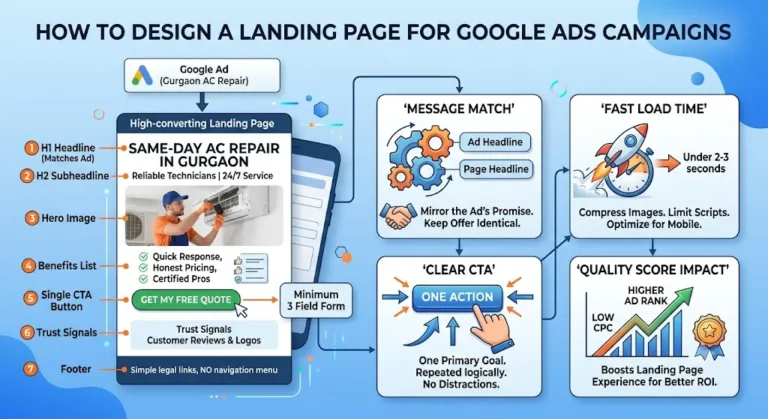
Google rewards relevance. Your Quality Score — the metric that quietly decides how much you pay per click and where your ad ranks — is built on three pillars: expected click-through rate, ad relevance, and landing page experience. Send Google Ads traffic to a generic homepage stuffed with navigation menus and unrelated services, and your landing page experience score drags the whole account down. A focused, ad-specific page can lower your CPC and lift your ad position without touching your bid.
Message match means the headline on your landing page should feel like a continuation of the ad, not a new conversation. If someone clicks an ad for “Same-Day AC Repair in Gurgaon,” and lands on a page headlined “Welcome to Our HVAC Services,” they hesitate — and that hesitation costs you the conversion.
Practical rules for tight message match:
Google Ads traffic is impatient by nature — people clicked because they wanted something now. A ppc landing page design that takes four or five seconds to load will lose a meaningful chunk of visitors before the page even renders, and Google factors load speed directly into your landing page experience score too.
Things that typically slow a Google Ads landing page down:
Keep the page lean: compress images, limit scripts to what’s essential for conversion tracking, and test on mobile specifically — most Google Ads traffic today arrives on a phone, not a desktop.
A google ads conversion page should have exactly one goal — call now, book a demo, get a quote, download the guide. The moment you add a second or third competing action, conversion rate drops, because visitors default to doing nothing when given too many choices.
What a clear CTA actually looks like:
A Google Ads landing page generally works best in this order:
This structure keeps the page working the way Google Ads traffic actually behaves — fast decisions, low patience for extra reading.
If your ad groups target meaningfully different intents (say, “repair” vs. “installation”), yes — a shared page waters down message match for at least one of them.
You can, but expect a lower Quality Score and weaker conversion rate, since a homepage is built to serve many intents at once, not the one specific intent behind a paid click.
Yes — landing page experience is one of the three components Google uses to calculate Quality Score, which directly influences your CPC and ad rank.
Ideally under 2-3 seconds on mobile. Every extra second of load time tends to push visitors back to search results before they even see your offer.
A normal website page usually has navigation, multiple links, and several goals. A landing page for Google Ads strips all of that away and exists for exactly one action tied to one ad.
No — a menu gives visitors an exit route away from the CTA. Google Ads landing pages convert better without one, since there’s nowhere to go except the action you want.
As few as the follow-up actually needs — usually name, phone or email, and one qualifying field. Every additional field reduces form completion rate.
It can, if the keywords share the same intent and offer. Once the intent splits — different service, different audience, different promise — message match breaks down and a separate page performs better.
Quality Score weighs landing page experience just as heavily as the ad itself. A slow page, weak message match, or a confusing CTA can drag the score down regardless of how well the ad is written.
Text matters more. Button copy that states the actual outcome (“Get My Free Quote”) consistently outperforms generic labels, whatever color the button is.