Dark Mode Website Design: Is It Actually Worth Building for Your Audience?
Dark Mode Website Design: Is It Actually Worth Building for Your Audience? Dark mode is worth building when your visitors...
Read More → Website redesign can become necessary when your site looks outdated, loads slowly, or fails to keep visitors engaged. Your website loaded fine five years ago, but that doesn’t mean it’s working for you now. If visitors bounce within seconds, your site looks dated on a phone, or you haven’t touched the design since Instagram Stories didn’t exist, you’re not imagining it — your website may be costing you business every day it stays the same.
Here’s how to know for sure, and what to do about it.
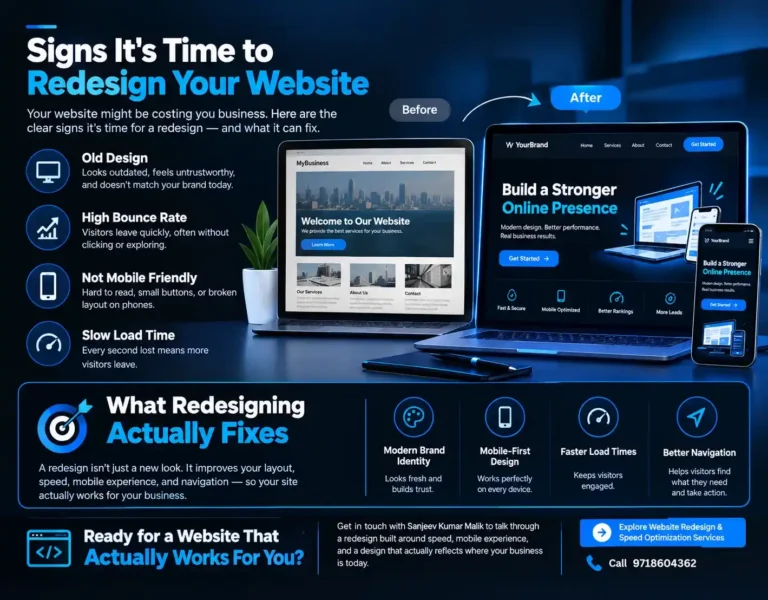
Design trends move fast, and so do visitor expectations. A site built even 3-4 years ago often carries tells that instantly signal “outdated” to a first-time visitor: boxy layouts, tiny stock photography, cluttered navigation menus, and fonts that scream early 2010s web design. None of that is a style preference issue — it’s a trust issue. People associate visual quality with business quality, fairly or not, and an old-looking site quietly tells visitors you might be old-fashioned in how you run things too.
If you look at your homepage and can’t remember the last time you changed anything besides swapping out a phone number, that’s usually the first sign.
A high bounce rate — visitors leaving after viewing just one page — is rarely a traffic problem. It’s almost always an experience problem. People are finding your site through search or ads, landing on a page, and leaving within seconds without clicking anywhere else.
Common causes worth checking:
If your analytics show bounce rates climbing, or sessions that last only a few seconds, that’s not a marketing problem to throw more ad budget at. It’s a sign the site itself is turning people away before they even get a chance to consider you.
More than half of web traffic today comes from phones, and that number keeps climbing. If your site still requires pinch-zooming to read text, has buttons too small to tap accurately, or breaks visually on smaller screens, you’re losing the majority of your potential visitors before they even see your offer.
This isn’t just about visitors leaving out of frustration — Google actively factors mobile usability into how it ranks pages. A site that isn’t genuinely responsive (not just “technically loads” on mobile, but actually designed for it) is working against you in search results too, not just in the visitor’s browser.
Every extra second a page takes to load increases the chance a visitor leaves before they’ve even seen your content. This is especially brutal for mobile users on slower connections. Slow load times usually trace back to a handful of fixable culprits: unoptimized images, bloated code from outdated page builders, too many third-party scripts, or hosting that hasn’t been reviewed in years.
The frustrating part is that slow load time compounds every other problem on this list — even a beautifully redesigned page loses its impact if it takes eight seconds to appear.
A proper website redesign isn’t about a fresh coat of paint. Done right, it means:
That’s the real difference between a redesign and a reskin — one changes how the site looks, the other changes how it performs.
If the core issues are outdated design, poor mobile experience, or slow load times, that’s a redesign territory — those are structural, not cosmetic. If it’s just old contact info or a few broken links, that’s a maintenance fix, not a full redesign.
There’s no fixed rule, but most sites start showing real wear after 3-4 years as design standards, browser behavior, and visitor expectations shift. The better trigger than a calendar date is watching your own bounce rate and mobile performance for warning signs.
It can, if it’s done carelessly — losing URLs, dropping content, or ignoring redirects can hurt rankings temporarily. Done properly, with redirects and content preserved or improved, a redesign usually improves rankings over time since page speed and mobile usability are both ranking factors.
Swapping a theme changes the surface look but often keeps the same underlying structure, code bloat, and mobile issues. A proper redesign rebuilds the experience around speed, usability, and how visitors actually behave on the site — not just a new coat of paint.
It depends heavily on site size and complexity — a small business site is a very different scope than a large multi-page catalog or e-commerce build. The right approach is to get a clear timeline estimate based on your specific site’s scope, not a generic number.
Often yes, but a redesign is also a good moment to review whether your existing content still serves visitors well. Outdated copy paired with a brand-new design creates a mismatch that visitors notice.
Not always. Hosting is one factor, but unoptimized images, heavy scripts, outdated plugins, and bloated page builders are just as often the real cause. A proper speed audit looks at all of these before pointing at hosting alone.
Cost depends on scope — number of pages, custom functionality, e-commerce needs, and design complexity all factor in. The best way to get an accurate number is a direct conversation about what your site actually needs.
Sometimes targeted fixes on high-traffic or high-bounce pages make sense as a first step, especially if budget or timing is tight. But if the mobile experience and load speed issues are site-wide, page-by-page fixes only delay the larger fix.
Look for someone who asks about your actual bounce rate, mobile traffic, and load time data before proposing a design — not someone who jumps straight to visuals. A redesign that doesn’t address the underlying performance issues just becomes a nicer-looking version of the same problem.
If two or more of these signs sound familiar, your website isn’t just due for an update — it’s actively working against your business goals right now. Every day it stays the same is another day of visitors bouncing, mobile users struggling, and slow pages quietly pushing people toward competitors.
Get in touch with Sanjeev Kumar Malik to talk through a redesign built around speed, mobile experience, and a design that actually reflects where your business is today. Explore website redesign & speed optimization services or call 9718604362 to discuss your site directly.