Dark Mode Website Design: Is It Actually Worth Building for Your Audience?
Dark Mode Website Design: Is It Actually Worth Building for Your Audience? Dark mode is worth building when your visitors...
Read More → A no-code website builder works fine — right up until it doesn’t. Most businesses start there because it’s fast and cheap, and for a lot of use cases, it stays fine forever. But there’s a point where the same drag-and-drop simplicity that got you online in a weekend starts working against you: a feature you need doesn’t exist, the design can’t go past a certain point, or your site slows down and there’s nothing you can do about it because you don’t own the underlying code. Knowing where that line sits — before you hit it — is the whole point of this comparison.
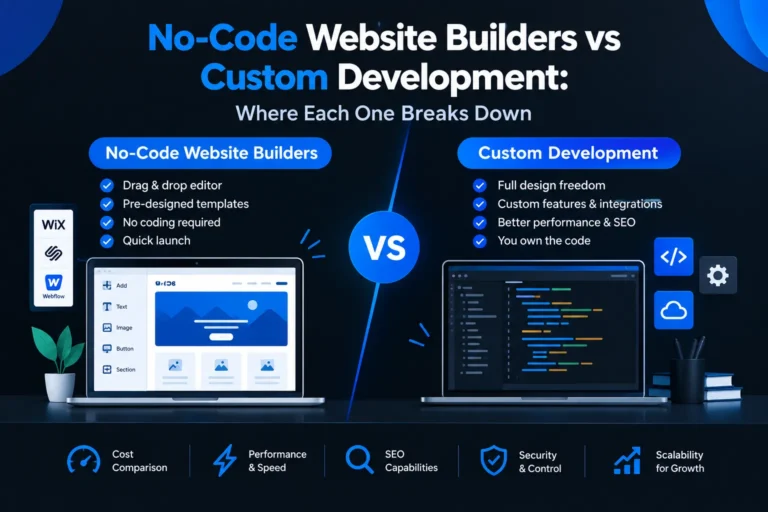
Platforms like Wix, Squarespace, and Webflow let you build a site by dragging elements onto a page, picking from templates, and configuring settings through a visual interface. No developer, no codebase, no hosting to manage separately — the platform handles all of it.
For a huge number of businesses, this is genuinely the right call. A local service business, a portfolio site, a simple brochure site for a small team — none of these need custom engineering. You get a live, reasonably polished site in days, at a fraction of the cost of custom development, and you can edit it yourself without calling anyone.
The limitations don’t show up on day one. They show up as the business grows, and they tend to cluster around a few specific points.
Design and functionality ceilings. Every no-code platform draws a line somewhere. You can customize a lot within the template system, but the moment you need something genuinely custom — a non-standard checkout flow, a specific integration, an interaction the builder just doesn’t support — you’re stuck. Drag and drop website tools are built for breadth, not for edge cases.
Performance you can’t fix yourself. No-code platforms run on shared infrastructure built for the average use case. If your site needs to load fast for a specific market, handle high traffic spikes, or serve content in a particular way for SEO, you’re limited by what the platform allows — you can’t optimize the underlying code because you don’t have access to it.
Vendor lock-in. This is the one businesses underestimate most. Your site, your content structure, and often your URLs are tied to that platform’s system. Migrating away later isn’t a simple export — it can mean rebuilding significant portions of the site from scratch, losing SEO equity in the process if URLs and structure change.
Platform dependency. You’re subject to the platform’s pricing changes, feature deprecations, and uptime. If the platform changes its terms, raises prices, or discontinues a feature your site depends on, you don’t have much recourse.
Scalability limits. A no-code site built for 500 visitors a month doesn’t always hold up gracefully at 50,000. Custom integrations, complex data structures, and high-volume traffic are where these platforms tend to strain hardest.
Custom development flips every one of those trade-offs, at the cost of more time and money upfront.
You own the code. There’s no platform sitting between you and your site. If you want to change hosting providers, add a feature, or rebuild part of the site, that’s entirely your call — nothing is locked to a third party’s ecosystem.
No functional ceiling. If it can be coded, it can be built. Custom logic, specific integrations, non-standard user flows — a developer can build exactly what the business needs instead of working within a template system’s boundaries.
Built for your actual traffic and SEO needs. A custom-coded site can be optimized at the code level for speed, structure, and search visibility in ways a shared platform simply can’t match, because you’re not competing for the same server resources or bound by the platform’s default architecture.
Scales with the business. When you outgrow your current setup, you extend it — you’re not migrating to an entirely new platform because you hit a wall.
The trade-off is cost and timeline. Custom development takes longer and costs more than picking a template, and it needs an actual developer or agency involved, not just someone comfortable with a visual editor.
A few questions usually settle it faster than a feature-by-feature comparison:
There’s no version of this answer that’s right for every business — a fast-growing e-commerce brand and a local service provider with five pages have genuinely different needs here, and the process of scoping a build out properly (from planning through launch) matters regardless of which path you take.
Lorem ipsum dolor sit amet, consectetur adipiscing elit. Ut elit tellus, luctus nec ullamcorper mattis, pulvinar dapibus leo.
Lorem ipsum dolor sit amet, consectetur adipiscing elit. Ut elit tellus, luctus nec ullamcorper mattis, pulvinar dapibus leo.
Lorem ipsum dolor sit amet, consectetur adipiscing elit. Ut elit tellus, luctus nec ullamcorper mattis, pulvinar dapibus leo.
Lorem ipsum dolor sit amet, consectetur adipiscing elit. Ut elit tellus, luctus nec ullamcorper mattis, pulvinar dapibus leo.
Lorem ipsum dolor sit amet, consectetur adipiscing elit. Ut elit tellus, luctus nec ullamcorper mattis, pulvinar dapibus leo.
Lorem ipsum dolor sit amet, consectetur adipiscing elit. Ut elit tellus, luctus nec ullamcorper mattis, pulvinar dapibus leo.
Lorem ipsum dolor sit amet, consectetur adipiscing elit. Ut elit tellus, luctus nec ullamcorper mattis, pulvinar dapibus leo.
Lorem ipsum dolor sit amet, consectetur adipiscing elit. Ut elit tellus, luctus nec ullamcorper mattis, pulvinar dapibus leo.
Lorem ipsum dolor sit amet, consectetur adipiscing elit. Ut elit tellus, luctus nec ullamcorper mattis, pulvinar dapibus leo.
Lorem ipsum dolor sit amet, consectetur adipiscing elit. Ut elit tellus, luctus nec ullamcorper mattis, pulvinar dapibus leo.
If you’re weighing a no-code builder against a custom build and don’t want to guess, it’s worth getting an honest outside read before committing either way — including what a proper planning-to-launch process actually looks like for your situation.
Sanjeev Kumar Malik will take a straight look at your requirements and tell you plainly whether a no-code tool covers what you need, or whether custom development is worth the extra investment. Check out sanjeevkumarmalik.in/website-development-services or call 9718604362 to get that assessment.