Dark Mode Website Design: Is It Actually Worth Building for Your Audience?
Dark Mode Website Design: Is It Actually Worth Building for Your Audience? Dark mode is worth building when your visitors...
Read More → A scalable ecommerce website is built for growth from the start, not just for the first few hundred orders. Indian ecommerce businesses need to prepare for sudden traffic spikes, multiple payment methods, mobile shoppers, larger product catalogs, and customers from different parts of the country. If the website infrastructure cannot handle that growth, performance and checkout problems can appear when the business needs the website most. Here’s what to plan before your ecommerce store starts scaling.
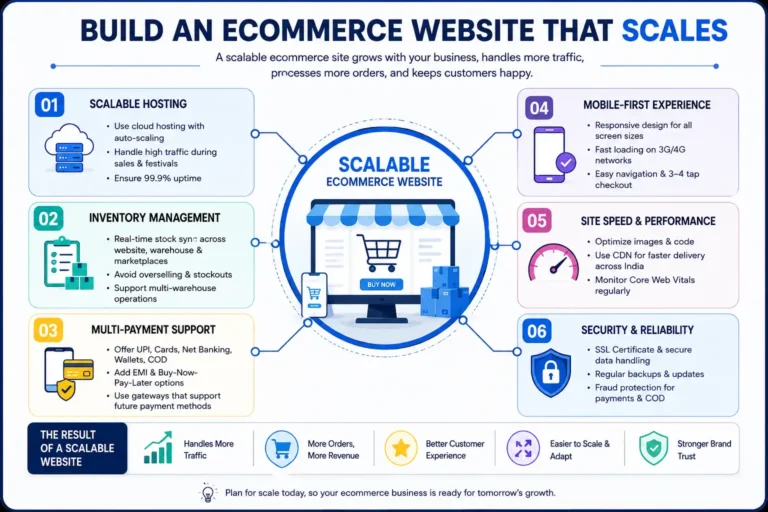
A scalable ecommerce website isn’t just one that “can handle traffic.” It’s one where four things hold up together as order volume, catalog size, and customer expectations grow: the hosting infrastructure, the inventory system behind the scenes, the payment experience at checkout, and how the whole thing performs on a mid-range Android phone with 3G-level speeds in a tier-2 city. Miss any one of these, and the other three don’t matter — a fast site with a broken payment gateway loses the sale just as fast as a slow one.
The mistake we see most often is sizing hosting for a “normal Tuesday” instead of the traffic spike that actually decides the year’s revenue. If your biggest sales day brings 20x your average traffic and your infrastructure can only handle 3x, the site slows down or crashes exactly when it matters most.
For an Indian ecommerce store, that means:
If your developer can’t tell you what happens to page speed at 10x your current traffic, that’s a gap worth closing before you invest more in marketing that drives traffic to a site that can’t hold it.
A spreadsheet works fine for 50 SKUs. At 500, it becomes a liability — someone sells an out-of-stock item, a refund has to go out, and the customer never comes back. Scalable inventory management means the stock count on your website, your warehouse, and (if you sell there too) marketplaces like Amazon or Flipkart, all update from one source of truth in real time.
This usually means an inventory management system integrated directly into your website’s backend — not a manual sync done twice a day. For multi-warehouse sellers, it also means the system can route orders to whichever warehouse has stock and is closest to the customer, which matters a lot for delivery timelines once you’re shipping pan-India.
India’s payment landscape is unusually fragmented compared to most markets, and that’s exactly why a narrow checkout kills conversions here faster than almost anywhere else. A store that only offers credit/debit cards is leaving out the large share of buyers who pay by UPI, and a store without Cash on Delivery is invisible to an entire segment of tier-2 and tier-3 shoppers who still don’t trust prepaying strangers online.
A checkout built to scale needs:
The bulk of Indian ecommerce traffic comes from mobile, and a large share of that is on mid-range devices over networks slower than what most sites are tested on. A store that looks great on a developer’s laptop over office wifi can still be borderline unusable on a ₹12,000 phone on 4G in a smaller town — and that gap is where a lot of “scalable” sites quietly lose the majority of their actual customers.
Building for that reality means:
A few patterns show up again and again in stores that hit a growth ceiling they didn’t see coming: choosing a platform based on what’s cheapest to launch rather than what holds up at 10x the SKU count; treating mobile as a “responsive version” of the desktop site instead of designing mobile-first; and adding payment methods reactively, one support ticket at a time, instead of building a checkout that can absorb new options as they emerge.
Whether you build on a customizable platform like Shopify, a headless commerce setup, or a fully custom build depends on your catalog size, growth timeline, and how much control you need over checkout and backend workflows. There’s no universal right answer here — a 200-SKU store growing steadily has very different needs from a 5,000-SKU catalog expecting a 5x jump in a single festive season. This decision is worth getting right early, since migrating platforms mid-growth is expensive and risky.
As a starting benchmark, plan for at least 10–20x your average daily traffic during peak sale periods like Diwali or end-of-season sales — actual multiples vary by category, but under-planning here is the single most common scaling failure.
Shopify scales well for most catalogs up to several thousand SKUs and handles infrastructure scaling automatically; custom development makes more sense once you need deep control over checkout logic, complex inventory rules, or integrations Shopify’s app ecosystem can’t cleanly support.
UPI is the default payment method for a large share of Indian online shoppers, and a checkout without it forces buyers toward less convenient options, which measurably hurts conversion rates.
Yes, particularly outside metro cities — COD remains an important trust bridge for buyers unfamiliar with your brand, though it can be limited to reduce fraud and RTO (return-to-origin) losses as the business matures.
Mobile-responsive means a desktop layout that resizes to fit smaller screens; mobile-first means the design and checkout flow are built for mobile constraints from the start, which produces a meaningfully better experience for the majority of Indian shoppers.
It keeps stock counts synced in real time across your website, warehouse, and any marketplaces you sell on, preventing overselling and the refund/trust damage that comes with it — a manual process that works at low volume breaks down fast at scale.
Usually a combination of unoptimized product images, an unindexed or poorly structured database as the catalog grows, and hosting that wasn’t built to handle the increased load — each compounds the others as traffic and SKU count rise.
above a few thousand rupees, EMI/BNPL options can meaningfully increase conversion by lowering the upfront commitment; for lower-ticket items the added checkout complexity often isn’t worth it.
Recurring slowdowns during traffic spikes, manual inventory reconciliation eating significant staff time, or a payment gateway that can’t add new methods without custom development are all signs the current build has hit its ceiling.
At the platform-selection stage — before development starts. Retrofitting scalability into a site built without it usually costs more than building it in from day one, and it almost always means downtime during your busiest growth period.
Ready to build an ecommerce website that won’t need a rebuild in a year? Sanjeev Kumar Malik has built ecommerce websites designed to handle real Indian traffic patterns, payment diversity, and mobile-first buyers. Get in touch or call 9718604362 to talk through what your store needs to scale.