Dark Mode Website Design: Is It Actually Worth Building for Your Audience?
Dark Mode Website Design: Is It Actually Worth Building for Your Audience? Dark mode is worth building when your visitors...
Read More → If you’re launching or scaling an online store in India, three names dominate the payment gateway conversation: Razorpay, PayU, and Cashfree — each strong in a different scenario, and the “best” one depends on your transaction volume, the payment methods your customers actually use, and how much control you want over the checkout experience.
A payment gateway isn’t just a “connect and forget” plugin. It sits at the exact moment your customer decides whether to complete a purchase or abandon the cart. A slow redirect, a missing UPI option, or a gateway that fails during high traffic (say, a flash sale) directly costs you revenue — not hypothetically, but in real, measurable drop-offs at checkout. That’s why this decision deserves more thought than picking whichever gateway a tutorial video mentioned first.
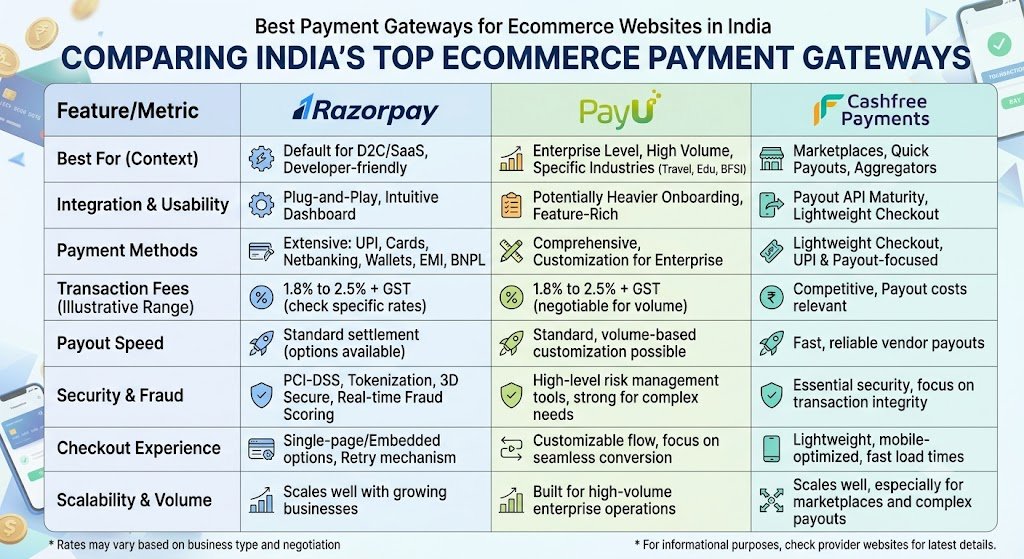
Razorpay has become the default recommendation for most Indian D2C and SaaS businesses, largely because of its developer-friendly integration and the sheer breadth of payment methods it supports out of the box — UPI, cards, netbanking, wallets, EMI, and Buy Now Pay Later options. Its dashboard is genuinely usable for non-technical founders, which matters when you’re the one reconciling payments at 11 PM.
PayU tends to edge ahead for businesses processing higher transaction volumes or needing more customization at the enterprise level. It has stronger presence in industries like travel, education, and BFSI, and its risk and fraud management tools are built for that scale. The trade-off is that onboarding can feel heavier, and the interface isn’t quite as plug-and-play as Razorpay’s for a small store.
Cashfree is often the sharper pick when payout speed matters — marketplaces, aggregators, or businesses that need to split payments and disburse to vendors quickly lean toward Cashfree because of its payout API maturity. Its checkout is lightweight too, which helps on mobile load times.
There isn’t a universal winner. A single-product D2C brand doing a few hundred orders a month has very different needs than a multi-vendor marketplace processing thousands of transactions daily — and the right gateway integration into your ecommerce website development should be chosen against that specific pattern, not a generic “top 5” list.
Most Indian gateways advertise a headline rate — typically somewhere in the 1.8% to 2.5% range per transaction — but the real cost picture includes GST on that fee, settlement cycle charges if you want faster payouts, and sometimes a flat fee on international cards or specific instruments like EMI. Two gateways with near-identical headline rates can end up costing meaningfully different amounts once you factor in your actual payment method mix. If 70% of your customers pay via UPI, a gateway with a genuinely low UPI-processing cost matters more than one that’s cheaper on card payments you rarely see.
At minimum, any gateway you integrate should be PCI-DSS compliant, support tokenization so you’re never storing raw card data on your own servers, and offer 3D Secure authentication for card transactions. Beyond the checklist, look at how the gateway handles fraud scoring — real-time risk flags on suspicious transactions save you from chargebacks later, which are far more expensive to fight than to prevent. If your developer is integrating this directly rather than through a plugin, insist on server-side signature verification for every webhook — this is the single most common security gap in DIY gateway integrations.
The technical strength of a gateway means little if the checkout flow itself is clunky. A few things worth checking before you commit:
A well-built ecommerce website should treat the payment gateway as part of the UX design, not a bolted-on final step.
India’s payment behavior is UPI-first for a large share of buyers, but that doesn’t mean cards, wallets, and EMI options should be an afterthought. Higher-ticket purchases often convert better with EMI visible at checkout, and cash-on-delivery still matters for certain categories and tier-2/tier-3 audiences. The gateways worth shortlisting are the ones that let you enable or disable specific methods based on order value or customer segment, rather than forcing a one-size-fits-all checkout screen.
Payment gateway integration isn’t a standalone task — it’s one piece of getting your online store’s foundation right, alongside product catalog structure, checkout flow design, and hosting that can handle traffic spikes. When this is planned as part of the overall build rather than added on later, you avoid the common scenario of re-architecting checkout six months in because the gateway choice didn’t scale with the store.
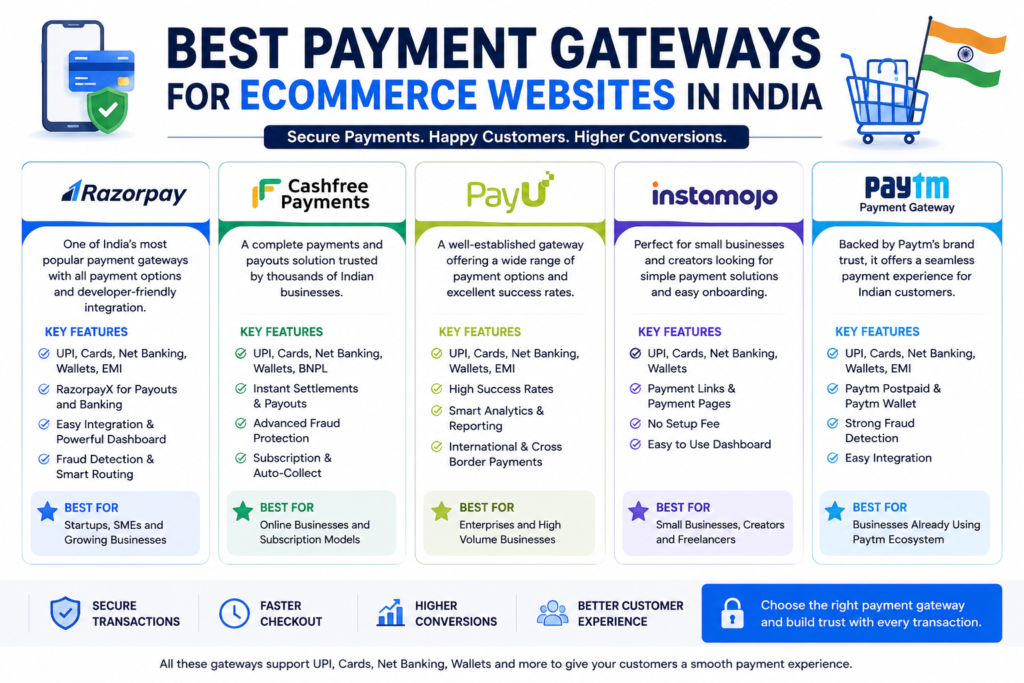
For low-to-mid volume stores, Razorpay and Cashfree are generally comparable on headline transaction fees. The real difference shows up in your specific payment mix — check UPI and wallet rates specifically, since those typically make up the bulk of transactions for smaller Indian stores.
Yes, and larger stores often do this for redundancy — if one gateway has downtime, transactions can route through the other. It adds integration complexity, so it’s usually worth doing once volume justifies it rather than from day one.
Most gateways set up a virtual merchant account as part of onboarding, so you don’t need a traditional bank-side merchant account separately in most cases. Requirements can vary slightly by gateway and business type, so confirm during onboarding.
Typically a few days to about two weeks, depending on how quickly your business documents (GST, PAN, bank details, website with clear terms and refund policy) are verified. Having these ready before you apply speeds this up considerably.
Not mandatory, but close to essential — UPI accounts for a large share of online transactions in India, and skipping it will visibly hurt your conversion rate compared to competitors offering it.
Reputable gateways auto-reverse failed transactions within a defined settlement window (often a few hours to a few days), but your checkout flow should clearly communicate this to the customer instead of leaving them uncertain.
Typically a few days to about two weeks, depending on how quickly your business documents (GST, PAN, bank details, website with clear terms and refund policy) are verified. Having these ready before you apply speeds this up considerably.
Not mandatory, but close to essential — UPI accounts for a large share of online transactions in India, and skipping it will visibly hurt your conversion rate compared to competitors offering it.
Reputable gateways auto-reverse failed transactions within a defined settlement window (often a few hours to a few days), but your checkout flow should clearly communicate this to the customer instead of leaving them uncertain.
Yes — gateways that redirect to an external page or load heavy third-party scripts can slow down checkout. Embedded or lightweight SDK-based integrations generally perform better on page speed.
Getting your payment gateway right is part of getting your entire store right. If you’re setting up a new ecommerce website or evaluating whether your current checkout is costing you sales, our team’s ecommerce website development work covers this exact piece — from gateway selection to checkout UX — as part of building a store that’s actually built to convert, not just built to launch.
📞 Get in touch: 9718604362