Dark Mode Website Design: Is It Actually Worth Building for Your Audience?
Dark Mode Website Design: Is It Actually Worth Building for Your Audience? Dark mode is worth building when your visitors...
Read More → Headless commerce is worth it for an Indian brand when its storefront has outgrown what a standard theme or template can do. That usually means several sales channels, heavy custom experiences, or performance problems on mobile networks that theme tweaks can’t fix. If you sell a modest catalogue through one website and your main problem is conversion or traffic, a well-built conventional store will serve you better and cost less. The rest of this post explains how to tell which situation you’re in.
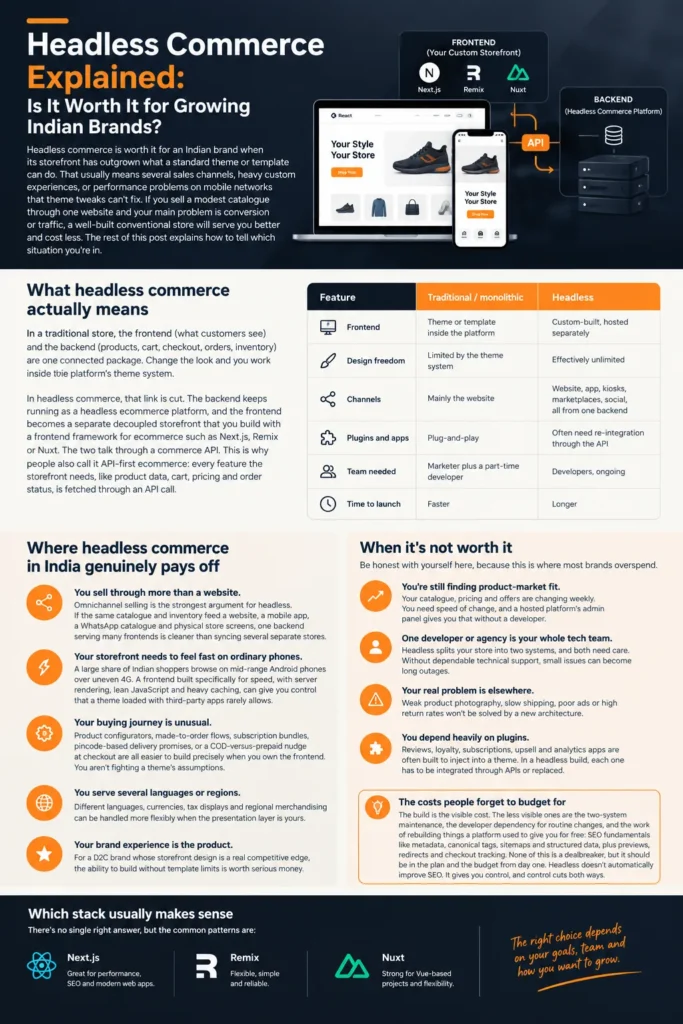
In a traditional store, the frontend (what customers see) and the backend (products, cart, checkout, orders, inventory) are one connected package. Change the look and you work inside the platform’s theme system.
In headless commerce, that link is cut. The backend keeps running as a headless ecommerce platform, and the frontend becomes a separate decoupled storefront that you build with a frontend framework for ecommerce such as Next.js, Remix or Nuxt. The two talk through a commerce API. This is why people also call it API-first ecommerce: every feature the storefront needs, like product data, cart, pricing and order status, is fetched through an API call.
Traditional / monolithic | Headless | |
Frontend | Theme or template inside the platform | Custom-built, hosted separately |
Design freedom | Limited by the theme system | Effectively unlimited |
Channels | Mainly the website | Website, app, kiosks, marketplaces, social, all from one backend |
Plugins and apps | Plug-and-play | Often need re-integration through the API |
Team needed | Marketer plus a part-time developer | Developers, ongoing |
Time to launch | Faster | Longer |
You sell through more than a website. Omnichannel selling is the strongest argument for headless. If the same catalogue and inventory feed a website, a mobile app, a WhatsApp catalogue and physical store screens, one backend serving many frontends is cleaner than syncing several separate stores.
Your storefront needs to feel fast on ordinary phones. A large share of Indian shoppers browse on mid-range Android phones over uneven 4G. A frontend built specifically for speed, with server rendering, lean JavaScript and heavy caching, can give you control that a theme loaded with third-party apps rarely allows.
Your buying journey is unusual. Product configurators, made-to-order flows, subscription bundles, pincode-based delivery promises, or a COD-versus-prepaid nudge at checkout are all easier to build precisely when you own the frontend. You aren’t fighting a theme’s assumptions.
You serve several languages or regions. Different languages, currencies, tax displays and regional merchandising can be handled more flexibly when the presentation layer is yours.
Your brand experience is the product. For a D2C brand whose storefront design is a real competitive edge, the ability to build without template limits is worth serious money.
Be honest with yourself here, because this is where most brands overspend.
The build is the visible cost. The less visible ones are the two-system maintenance, the developer dependency for routine changes, and the work of rebuilding things a platform used to give you for free: SEO fundamentals like metadata, canonical tags, sitemaps and structured data, plus previews, redirects and checkout tracking. None of this is a dealbreaker, but it should be in the plan and the budget from day one. Headless doesn’t automatically improve SEO. It gives you control, and control cuts both ways.
There’s no single right answer, but the common patterns are:
Pick the backend for what your operations team needs day to day, then choose the frontend framework for what your developers can maintain. Taking a trendy stack that nobody on your team knows is how projects stall.
If you answered yes to most of these, headless is worth a serious look. If you hesitated on question 3 or 5, fix that first.
If you’re thinking about 10-to-30-minute delivery partnerships or dark-store integrations, an API-first backend makes real-time inventory sync and delivery-partner connections easier to manage. I covered that side in detail in my post on how quick commerce integrations are changing ecommerce website development. Read it alongside this one if faster delivery is part of your plan.
You don’t have to rebuild everything at once. Many brands go headless in stages: keep the existing backend, rebuild the highest-traffic pages first (home, collection and product pages), leave checkout on the platform’s own secure flow initially, and expand from there. It cuts risk, lets you compare results, and gives you an exit if the numbers don’t justify continuing. If you want to see how this fits into a wider build, my Website Development Services page covers the different approaches.
It’s an ecommerce setup where the part customers see (the storefront) is separate from the part that runs the business (products, cart, orders, inventory). The two connect through APIs, so you can redesign or add new storefronts without touching the backend.
Usually not at the start. If you have a single website, a small team and a changing catalogue, a well-built hosted store gives you more speed for less cost. Headless starts to make sense when you’ve hit real limits or need several sales channels.
It can, mainly through faster pages and full control of markup, but it doesn’t happen automatically. Metadata, sitemaps, structured data and redirects all have to be built deliberately, and a poorly built headless site can rank worse than a simple one.
It depends on the catalogue size, the number of integrations, the platform licences and the design complexity, so any fixed number would be a guess. What holds true is that it costs more than a themed store to build and more to maintain, and the estimate should include both.
Yes. Shopify offers APIs and its own framework, Hydrogen, for building a custom storefront while your team keeps the familiar admin for products and orders. Some apps that inject into themes won’t work as they are and will need alternatives.
Next.js is the most common choice because of its server rendering and large ecosystem. Remix, Nuxt and Astro are also used. The best framework is the one your developers can maintain for years.
Yes, but the integration is handled differently. Many brands keep checkout on the platform’s hosted, secure flow at first and connect payment gateways through it, which reduces risk and speeds up launch.
It ranges from a few weeks for a focused rebuild of key pages to several months for a full replatform with custom integrations. The scope and the number of third-party tools connected matter far more than the framework.
Yes, and for most growing brands it’s the safer route. Start with the pages that get the most traffic, keep checkout on the existing platform, and measure the results before expanding.
Headless separates the frontend from the backend. Composable goes further and splits the backend itself into best-of-breed pieces, for example separate services for search, cart, payments and content. A composable stack is usually headless, but a headless one isn’t necessarily composable.
Send me your current store link and tell me what’s holding it back: slow mobile pages, a channel you can’t serve, a design you can’t build. I’ll give you an honest view of whether headless is worth it for your brand or whether a simpler fix will do. See how I work at sanjeevkumarmalik.in/website-development-services or call Sanjeev Kumar Malik on 9718604362.