Dark Mode Website Design: Is It Actually Worth Building for Your Audience?
Dark Mode Website Design: Is It Actually Worth Building for Your Audience? Dark mode is worth building when your visitors...
Read More → Most website projects don’t go wrong during development. They go wrong in the first week, when the brief says “modern, clean, and easy to use” and everyone nods as if that means something.
If you want to know how to brief a web developer properly, the short version is this: write down what the website must do for your business, who it’s for, what’s in and out of scope, how you’ll measure success, and who on your side can approve decisions. Everything else is detail. The rest of this post is that detail.
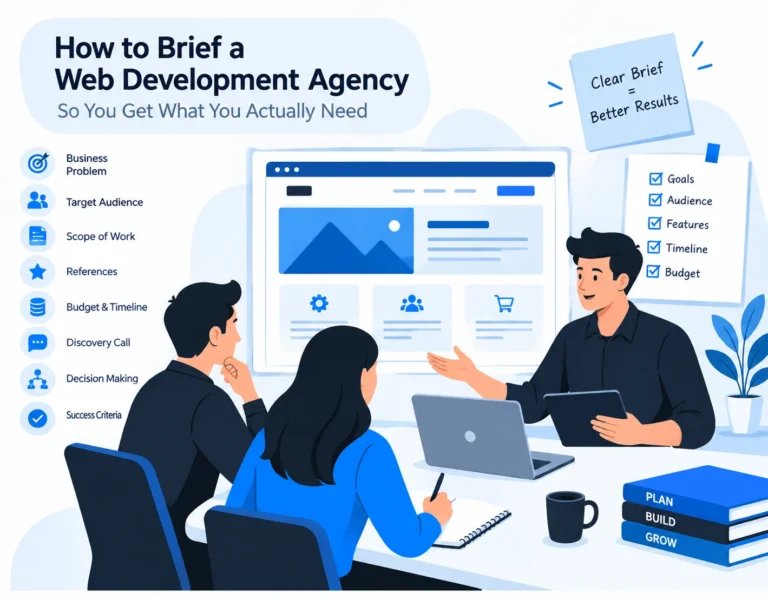
An agency can build almost anything. What it can’t do is guess why you need it.
“We need a new website” is a solution. The brief should start with the problem behind it. Some real examples of how that sounds:
Each of these leads to a different site. The first needs strong service pages and forms. The second needs a proper information architecture. The third is a performance and checkout problem, maybe not a redesign at all.
Write two or three sentences of this at the top of your website project brief. It’s the most useful paragraph in the whole document.
“Everyone” is not an audience. Describe the one or two types of visitors that matter most: a facility manager comparing three vendors, a first-time buyer on a phone, a returning customer reordering.
Add what those people are trying to do and what usually stops them. A developer who knows your visitor is on a 4G connection in a hurry will make different choices than one who assumes a desktop user with time to browse.
This is where most briefs are thinnest and where most disputes begin. A proper scope of work for a website answers plain questions:
If something isn’t written down, assume the agency and you have two different pictures of it.
Sharing three sites you admire helps. Sharing two you dislike helps more.
For each, say specifically what you’re reacting to: “the navigation feels effortless,” “the product pages are cluttered,” “the checkout asks for too much.” Avoid pointing at a site and saying “make it like this,” because you may be reacting to a feature that took a year to build.
Competitor sites are worth including too. Not to copy, but so the agency can see what visitors will compare you against.
Hiding your budget doesn’t get you a better price. It gets you proposals that don’t match what you can spend, or a scope that quietly shrinks halfway through.
Give a range, or at least a ceiling. A good agency will tell you what that range realistically covers and what you’d have to trade off. That conversation is more valuable than a surprise quote.
For timelines, separate real deadlines (a product launch, a campaign, a trade show) from preferred ones. Real deadlines shape the scope. Preferred ones can flex.
A good discovery call isn’t a sales pitch. It’s the agency asking you questions you hadn’t thought about, and you learning how they think.
Pay attention to whether they ask about:
If they jump straight to quoting without probing any of this, the quote is probably built on assumptions. That’s worth knowing before you sign.
Come prepared, too. Have your brief ready, but treat it as a starting point. Requirements gathering is a two-way process, and the strongest briefs get sharper after this call.
Stakeholder alignment sounds like corporate jargon until you’ve lived without it. The classic version: the designer presents, the MD approves, the sales head sees it two weeks later and wants changes, and now the timeline is gone.
Before kickoff, settle three things:
Vague success criteria produce vague websites. Define a few things you can actually check:
Ownership deserves special attention. Ask directly: will the domain, hosting, and source code be in your name? It’s an easy question now and a painful one later.
Sometimes a brief reveals that you don’t need custom work at all. If your needs are simple and you’re comfortable with templates, a builder might do the job. We’ve broken down where those tools help and where they fall short in our post on AI website builders and professional development (replace with the direct blog URL when you publish).
If your requirements include custom logic, integrations, performance targets, or a structure a template can’t handle, that’s when working with a professional team pays off, and a strong brief is how you make it work.
You don’t need a 30-page document. One or two pages covering these headings is enough:
If you can fill in nine of these and you’re unsure about the tenth, good. That’s exactly what the discovery call is for.
One to three pages is usually plenty. Length matters less than clarity. A tight two-page brief with real goals and a clear scope beats a long document full of vague adjectives.
The business problem the site needs to solve. Design preferences and feature lists all flow from that. Without it, the agency is building to taste instead of purpose.
Say so. Write down what you know: the problem, the audience, the constraints. Then ask for a paid or unpaid discovery phase to explore the rest. Pretending to have all the answers usually costs more than admitting you don’t.
Yes, at least a range. It lets the agency tell you what’s realistic and propose options that fit. Withholding it tends to produce mismatched quotes and wasted time on both sides.
The brief explains the why: goals, audience, context. The scope of work defines the what: deliverables, features, pages, exclusions, and timelines. The brief usually comes first, and the scope is finalised with the agency after discovery.
The person managing the project, the final decision-maker, and anyone whose team will use or depend on the site. Keeping the group small but complete avoids the “surprise stakeholder” problem later.
Ask the agency upfront how change requests work. Most teams have a process: assess the impact on cost and timeline, agree in writing, then proceed. Small tweaks are normal; new features are a scope change.
It varies by agency, so ask before signing. What matters is that the number of rounds is stated in the agreement, and that feedback comes from one consolidated source rather than five separate emails.
It should be spelled out in the agreement before work starts. Ask specifically who holds the domain registration, hosting account, and source code, and what you receive at handover.
Absolutely. You don’t need to know frameworks or hosting terms. Describe the business goals, the customers, and how you want the site to work in plain language. Translating that into technical decisions is the developer’s job.
If you’ve read this far, you’re closer to a solid brief than most people who contact an agency. Bring your draft, even a rough one, and we’ll go through it together: what’s clear, what’s missing, and what it means for scope and timeline.
Have a website project in mind? Visit Website Development Services by Sanjeev Kumar Malik or call 9718604362 to talk it through.