Dark Mode Website Design: Is It Actually Worth Building for Your Audience?
Dark Mode Website Design: Is It Actually Worth Building for Your Audience? Dark mode is worth building when your visitors...
Read More → You’ve got an ad campaign ready to launch, and suddenly you’re stuck on one question: should traffic land on your homepage, or on a dedicated page built just for this offer? Get this wrong and you either burn ad spend on visitors who bounce off a cluttered homepage, or you build a landing page for something that actually needed a full site. The two aren’t interchangeable, and picking the right one comes down to what you’re trying to get someone to do.
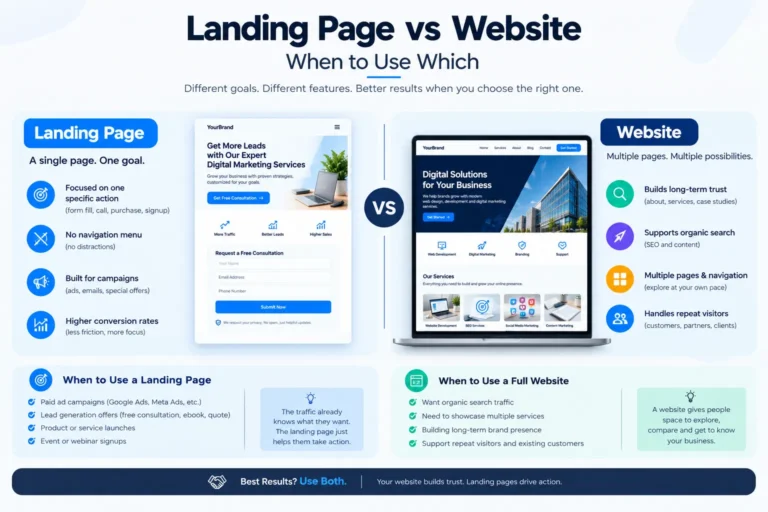
A website is your business’s permanent home on the internet — multiple pages, navigation menus, an “About” section, a blog, service pages, contact details. It exists to inform, build trust over time, and let visitors explore at their own pace. Someone can land on any page and still find their way around.
A landing page is a single, standalone page built around one goal. No navigation menu pulling attention away, no competing links, no “explore our other services” distraction. It exists to get one specific action done — a form fill, a call, a purchase, a signup — from visitors who arrived already interested, usually through an ad, an email, or a campaign link.
Think of a website as a store with multiple aisles, and a landing page as a single counter with one product and one cashier.
Landing pages earn their keep when there’s a specific goal tied to specific traffic:
The common thread: the traffic source already told the visitor what they’d get. The landing page just has to close the loop, fast, with zero distractions.
A website is what you need when:
If someone searches “website development services near me,” they’re not looking for a single-offer page — they want to browse, compare, and get a feel for who you are. That’s a job for a full site, not a landing page.
Yes — and this is where most businesses get the most value. A well-built website acts as the foundation: it ranks in search, builds credibility, and houses everything about your business. Landing pages then get built off that foundation for specific campaigns — a paid ad for landing page design services, for example, can point to a dedicated landing page instead of your general Landing Page Design & Development service page, while someone browsing your Website Development Services organically still finds the full picture.
The two aren’t competitors. A landing page without a website behind it can feel disconnected and less trustworthy once someone starts digging. A website without landing pages means every ad dollar sends traffic to a page that’s trying to do five jobs at once — and doing none of them well.
If you run any paid campaigns or lead-gen offers, yes — the website builds your long-term presence, and landing pages handle specific conversion goals without diluting either one.
It can, but it’s not built for it the way a full site page is — landing pages are optimized for conversion, not for the broader content depth search engines reward for organic ranking.
One per active offer or campaign is the general rule — a landing page for a specific service ad, another for a lead magnet, and so on, rather than one page trying to cover everything.
Usually yes, since it’s a single focused page rather than a multi-page site with navigation and structure — but the value comes from matching it to the right campaign, not just the lower build cost.
A dedicated landing page almost always wins here — homepages carry navigation and multiple messages that dilute the one action your ad promised, which tends to raise cost-per-lead.
Technically yes, but it defeats the purpose — a homepage is built to let people explore, while a landing page is built to remove every option except the one you want them to take.
Visitors who want to verify you before converting — checking your other services, reading about your process — won’t find anywhere to look, which can hurt trust for higher-consideration offers.
Basic on-page SEO still helps if the page might get organic or shared traffic, but the priority stays conversion-first — depth-focused SEO content belongs on your main website instead.
Just long enough to answer the one objection or question standing between the visitor and the action — website pages can go deeper since visitors there are browsing, not deciding on the spot.
It’s better to build a separate landing page per campaign or offer — mismatched messaging between the ad and the page it lands on is one of the fastest ways to lose a visitor’s trust.